 Login AI
Building reinforcement learning systems
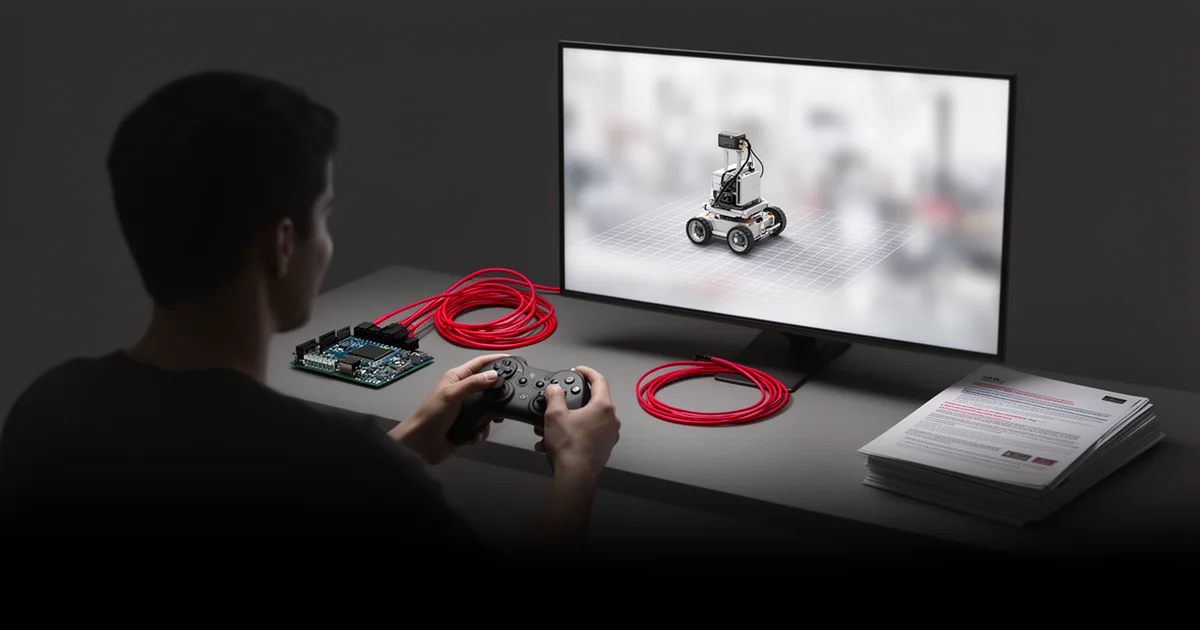
We build RL systems: an environment simulator, a reward function, and agent training. We verify the policy on historical data and in a limited pilot before a full launch.
The agent learns in a simulator and optimizes a long-horizon goal.
Pricing
from ₽2,500,000
per project
This is the lower bound of a project. We scope the exact quote after a brief: it depends on volume and the number of integrations.
Capabilities
Environment simulator
The environment is modeled before training: the simulator runs a million steps a minute, so the agent gathers experience far faster than real time.
Reward function
The reward describes the goal in numbers and weighs constraints alongside the payoff.
Historical verification
We run the policy on historical data before any real intervention.
Limited pilot
A launch starts on a limited loop with manual control, not the whole system.
From request to result
1
Task definition
We state the goal, constraints, and cost of a mistake: RL does not fit every task.
2
Simulator and reward
We build an environment model and describe the reward together with constraints.
3
Training and verification
We train the policy and verify it on historical data before any real intervention.
4
Limited pilot
We launch on a limited loop with manual control and a comparison against the current solution.
Check if it fits you
Good fit
A simulator or history exists
The environment can be modeled or reconstructed from logs: the agent learns without risk.
A long, multi-step goal
The result depends on a sequence of actions, not a single decision.
Not a fit
A mistake is irreversible and costly
Where one wrong action cannot be undone, learning on the live system is not allowed.
No numeric goal
Without a measurable reward the agent has nothing to optimize, and RL becomes brute force.
What you get
−12%
holding cost in the simulation
The agent optimized the ordering policy in a simulator and passed verification on historical data.
−23% downtime
Less equipment downtime
The agent picks a maintenance schedule in the simulator, so equipment downtime drops 23% against the fixed routine.
10⁶ steps/min
Simulator speed
The simulator runs a million steps a minute, so the policy finishes training within a few hours of cluster time.
8 weeks
Time to pilot
The simulator and the first trained policy land in eight weeks, so the team sees the effect before the pilot launch.
How the system is built
The simulator is the base
The simulator is the base: the agent learns in an environment model while the live system stays untouched until verification.
The reward describes the whole goal
The reward describes the whole goal together with constraints, so the agent seeks a profitable and allowed solution the team is ready to accept in real operations.
Randomness is controlled
Randomness is controlled by a series of runs: several trainings with different seeds show whether the policy is stable under a shift in the environment, and the team picks the policy with the best benchmark on history.
Historical verification is mandatory
Historical verification is mandatory: the policy is compared with the current solution on a held-out period, so the team sees the effect before any real intervention in the system.


Where the solution pushes back
- 01
A simulator diverges from reality
A policy perfect in the model loses quality on the live loop. A simulator diverges from reality, so the policy is checked on history.
- 02
The reward invites exploitation
The agent finds a loophole and reaches the maximum the roundabout way. The reward invites exploitation, so we tighten the rules before launch.
- 03
One-off decisions
Where the action is single, analytics is enough. Training is overkill for one-off decisions, so we pick a simpler method.
- 04
The cost of training
Training pays off with a clear metric and a ready simulator. A training run holds the cluster for a few days, so we estimate the return before the start.
Where we apply it
Where we apply it
The agent runs warehouse inventory and picks the reorder moment from daily demand.
A scheduler assigns shifts and machines across the shop floor load for the coming week.
A robot drills a trajectory in the simulator and carries it to the real stand without risk.
What the work includes
What the work includes
We describe the environment in code and replay the agent's steps in the simulator on every run.
We assemble the reward function with its constraints and the cost of a mistake for the agent.
We train the policy and compare it with the current solution on a held-out period of records.
Technologies
The technologies we use in our work and their role in a project.
Environment and training
The simulator is built in Python, training runs on PyTorch, experiments are versioned in MLflow, and environment state is stored in PostgreSQL.
Cost calculator
This is an indicative range, not a quote. We scope the exact estimate after a brief: it depends on volume and the number of integrations.
Agents
Environment complexity
Custom simulator
Add-ons
Support
Year one: updates and monitoring, a reply within 2 business days.
Service
Building reinforcement learning systems
The estimate covers our team's work. Hardware, third-party service licences and travel are added on request.
Estimated cost
₽3M
Timeline
6 wk
Frequently asked questions
Is it always neural networks?
No. For a small number of states a tabular policy reaches the same result and reads by eye. The choice depends on the task.
How is safety verified?
The policy does not run on the live system at once: simulator and history first, then a limited pilot under control.
Why not just A/B?
A/B fits a single decision. When the sequence of steps matters, an environment model is needed, or the effect cannot be separated from chance.
How long does it take?
The simulator and first trained agent start at eight weeks; the real pilot depends on the cost of a mistake and the loop.
What teams add to this service
Ready to discuss your task?
Leave a request – we'll get back with a proposal and a preliminary estimate.
Contact us