 Login AI
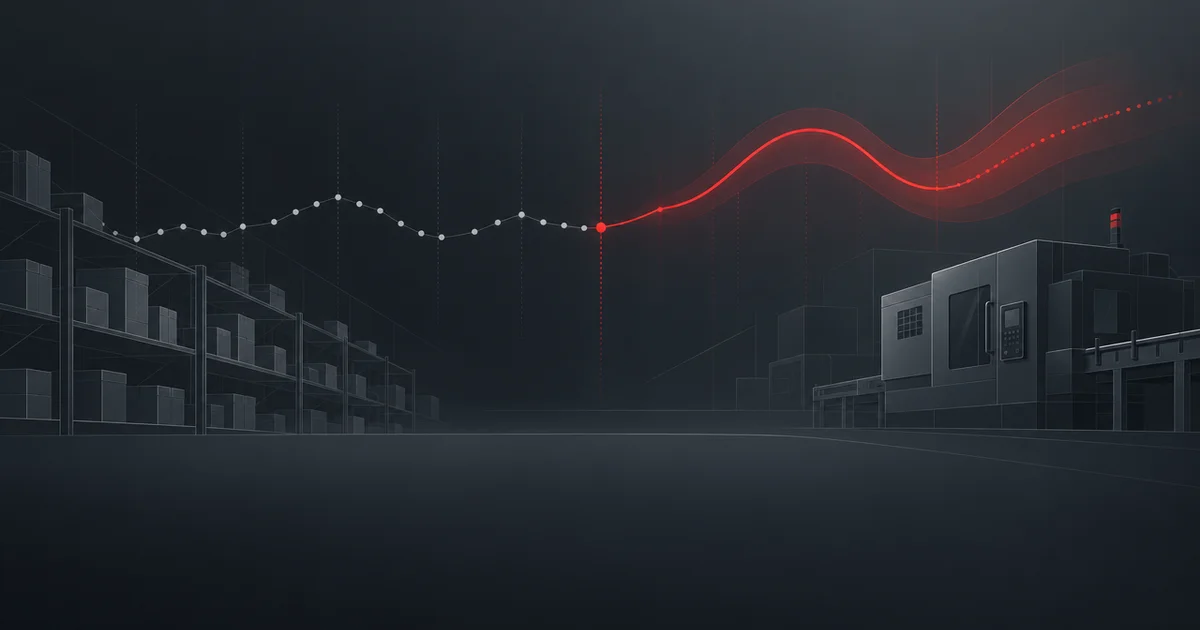
Building predictive analytics systems
We build predictive models on your data: demand, churn, and failure forecasts. We validate on history, measure the error, and embed the result into decisions.
The model forecasts demand, churn, and equipment failure ahead of time.
Pricing
from ₽2,000,000
per project
This is the lower bound of a project. We scope the exact quote after a brief: it depends on volume and the number of integrations.
Capabilities
Forecast from history
We validate the model on a past period, not on a random sample from the future.
Error in money
We translate model error into overstock, stockouts, and lost sales, not an abstract percentage.
Signals from processes
We gather signals from ERP, CRM, and logs, not just one report.
Decision next to the forecast
The forecast lands where the decision is made: a dashboard, a planning system, or a purchasing rule.
From request to result
1
Data audit
We review which signals exist and how far back they go: without history, no model is possible.
2
Feature schema
We fix features and the forecast horizon, and agree on the metric and allowable error.
3
Training and validation
We train on history, validate on a past period, and measure the error in business units.
4
Embedding into the process
We connect the forecast to a dashboard or planning system and add drift monitoring.
Check if it fits you
Good fit
Event history exists
Sales, churn, and failures are recorded over a sufficient period.
A recurring decision
Purchasing, planning, or maintenance repeats: the forecast fits into the cycle.
Not a fit
Too little or one-off data
Without history no model is possible, and only an expert forecast remains.
The process will not change
A forecast without a process change brings no value even when it is accurate.
What you get
−20%
excess inventory
The model computed demand from sales history, and purchasing leveled out warehouse overstock.
Fewer leftovers
Purchasing on forecast
Purchasing leans on the forecast, so overstock and stockouts shrink together. Last month stops being the only anchor.
Planned ahead
Failure before downtime
Equipment failure is predicted from telemetry before downtime, and maintenance is planned ahead. The stop goes into a planned schedule.
Before the last call
Churn from behavior
Customer churn shows in behavior changes, and retention kicks in before the last call. The signal comes earlier than the cancellation.
In rubles
Error in money
Overstock, stockouts, and lost sales are counted in money. Model error is visible in the budget, so decisions rest on figures.
How the system is built
Data into the model
We gather sales history, telemetry, and churn events into one dataset. Here we clean duplicates and align units, so the model reads a consistent picture before training starts.
Features and horizon
From history we pull features: seasonality, promotions, line load, customer activity. The horizon sets how far ahead the forecast goes.
Training and validation
We split the history into training and a held-out set, train the model, and measure error on past periods. The held-out set shows how the model behaves on data outside the training sample.
Drift monitoring
After launch we watch data drift and production metrics. When the distribution shifts, the model is retrained and compared with the previous version.


Where the solution pushes back
- 01
A regime change is out of scope
A new competitor or regulation breaks the learned dependency, and a forecast misses such a regime change. We track these shifts separately, outside the model.
- 02
Data cleaning
Duplicates and mismatched units distort the features, so data cleaning happens before training. Data cleaning is a required step, or the forecast leans on noise.
- 03
The model goes stale
Drift is monitored and the model retrained, so this is ongoing work. The model goes stale, and support is planned as a process.
- 04
Accuracy and the horizon
Long-range forecasts are weaker than short ones almost always. Accuracy depends on the horizon, and we name it honestly for each term.
Technologies
The technologies we use in our work and their role in a project.
Data and models
Data is collected in ClickHouse, features are computed in Airflow, models train on PyTorch and scikit-learn, and the result is stored in PostgreSQL.
Cost calculator
This is an indicative range, not a quote. We scope the exact estimate after a brief: it depends on volume and the number of integrations.
Models and use cases
Complexity
Online scoring
Add-ons
Support
Year one: updates and monitoring, a reply within 2 business days.
Service
Building predictive analytics systems
The estimate covers our team's work. Hardware, third-party service licences and travel are added on request.
Estimated cost
₽2.36M
Timeline
5 wk
Frequently asked questions
How accurate will the forecast be?
It depends on the horizon and process stability. We show the error on historical validation before the start instead of promising a number.
What if there is little data?
Then we build a simple model or rule and say honestly that deep learning will not pay off.
Where does the forecast land?
In a dashboard, a planning system, or a purchasing rule, where the decision is made, not a separate report.
Who watches quality?
Drift monitoring on the platform plus periodic retraining. This is ongoing work, not a one-off project.
How do we validate the model before launch?
We split the history into training and a held-out set and measure error on periods the model never saw. We also show which features influence the forecast most, so the result can be explained to the business.
What do we need from your team?
Access to historical data and the business rules: how you count overstock, stockouts, and lost sales. We bake that link into the quality metric, or the model optimizes the wrong thing.
How does the forecast reach the process?
We wire the output into a dashboard, a planning system, or a purchasing rule over an API. We do not build a separate report nobody reads.
What teams add to this service
Related Services
Part of Solutions
Implementation Examples
×4.5
Stream data processing speed
Ready to discuss your task?
Leave a request – we'll get back with a proposal and a preliminary estimate.
Contact us