 Login AI
Integrating AI assistants with CRM
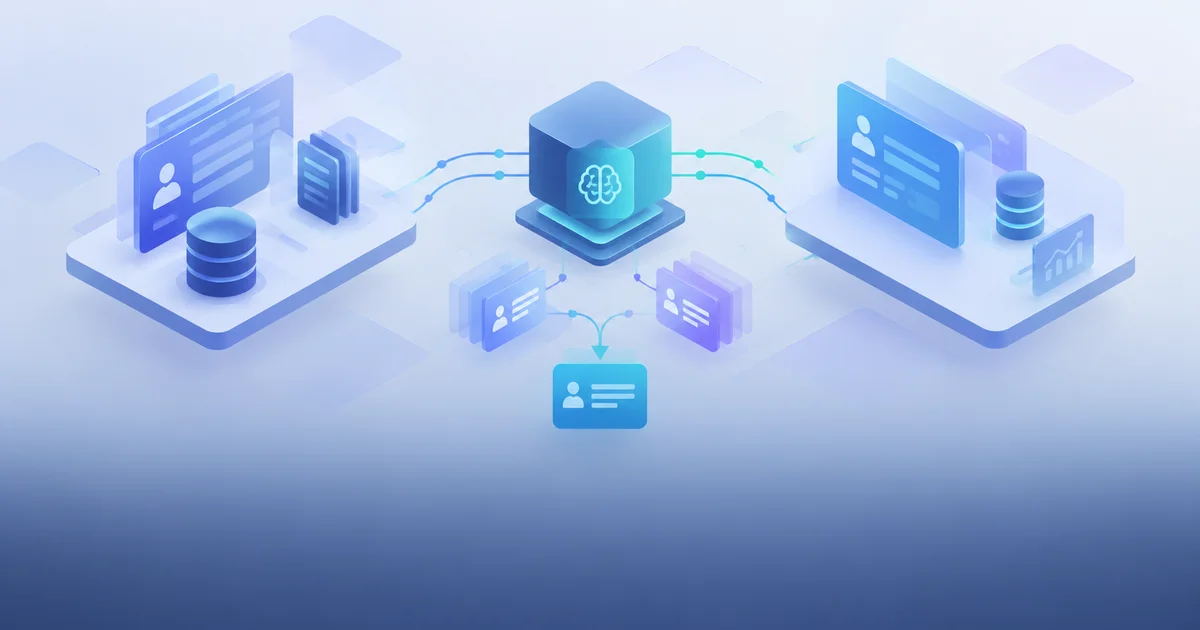
We connect AI assistants to your CRM: the agent reads conversation and deal history, updates cards, creates tasks, and hands the dialog to a manager with full context.
The agent sees the customer history and deals in the CRM and updates cards itself.
Pricing
from ₽900,000
per project
This is the lower bound of a project. We scope the exact quote after a brief: it depends on volume and the number of integrations.
Capabilities
Context without re-asking
The agent pulls conversation history, deals, and order status from the CRM before the first question.
One record, no duplicates
The outcome lands in the card once: a call, an email, and a chat do not become three copies.
Handoff to a manager
On escalation the manager gets the transcript, the reason, and the next step, not an empty thread.
Rights and roles
The agent works within the role's rights: it sees only the fields and deals open to that user.
From request to result
1
CRM audit
We review objects, fields, and rights: what the agent may read and write, and what stays closed.
2
Data schema
We fix entity mapping and dedup rules: one deal per customer, one log per dialog.
3
Agent integration
We connect the agent to the API, build read and write scenarios, and set the technical account's rights.
4
Pilot and launch
Two weeks on real conversations: we measure closed dialogs and card edits, then move to production.
Check if it fits you
Good fit
A dedicated CRM with an API
The agent connects to Битрикс24, amoCRM, or Salesforce directly, without core changes.
Requests across chat, email, telephony
The agent merges the channels into one deal and removes manual copy-paste.
Not a fit
A CRM kept in Excel
No API and no single data model: migration first, the agent second.
Disputed decisions on autopilot
The agent does not confirm refunds or money-related writes on its own; those stay with a person.
What you get
−40%
time spent gathering context
The agent pulled the order and customer history from the CRM before the first reply and created a manager task on disputed amounts.
What the delivery includes
History before the first question
The agent pulls conversation history, open deals, and order status before the first question. The customer skips retelling the story.
The outcome written once
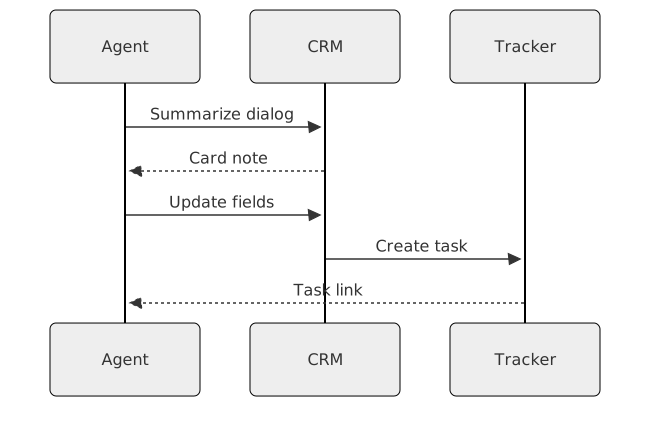
The agent adds a card note, updates fields, and creates a task. The outcome is written once, so a call, an email, and a chat stay one deal.
Escalation with a reason
The thread goes to the manager with the reason and a proposed next step. Escalation starts from facts, so the dialog is on point.
Rights by role
The agent sees only the fields and deals open to the user and works within the role's rights. A separate technical account with reduced rights blocks access to other people's data.
Metrics in the CRM
The share of dialogs closed without a manager, the number of tasks the agent created, and the records fixed by hand. Integration metrics live in the CRM itself.
How the system is built
Context before the question
The agent pulls conversation history, open deals, and order status before the first question, so the customer gets straight to the point.
An action in the card
The agent adds a note, updates fields, and creates a task, so the outcome is written once in one card, and the team reads the current history without manual entry.
Escalation to a manager
On escalation the thread goes to the manager with the reason and a proposed next step, and the dialog starts from facts.
Rights by role
The agent works within the role's rights and sees only the fields open to it, while a separate account blocks other people's data.




Where the solution pushes back
- 01
Integration without an API
If the CRM lives in spreadsheets without an API, the integration starts as a data migration project. The agent connects only after the data moves.
- 02
You need a process owner
Without an owner of the sales process, the agent repeats the chaos: the team sets the field rules, and card consistency depends on them.
- 03
Routine goes to the agent, money to a person
Telephony and manual checks on disputed refunds stay on your side. The agent takes over context gathering and routine, while money decisions stay with a person.
- 04
Cost depends on the system count
Cost depends on the number of entities and integrations: every new system in the loop adds mapping maintenance, so we fix the scope before the start.
- 05
Data stays in the perimeter
If customer data must stay inside your perimeter, the agent runs on your infrastructure, and that is a separate part of the project.
Technologies
The technologies we use in our work and their role in a project.
CRM and event flow
The agent talks to Битрикс24, amoCRM, or Salesforce through their APIs. Changes fan out through Kafka, and card fields map onto the PostgreSQL schema.
Cost calculator
This is an indicative range, not a quote. We scope the exact estimate after a brief: it depends on volume and the number of integrations.
Synced objects
Sync mode
Legacy API
Add-ons
Support
Year one: updates and monitoring, a reply within 2 business days.
Service
Integrating AI assistants with CRM
The estimate covers our team's work. Hardware, third-party service licences and travel are added on request.
Estimated cost
₽1.26M
Timeline
3 wk
Frequently asked questions
Where does the agent write results?
Into the CRM card: a note, fields, and a task. The agent keeps no separate store, so there is no second source of truth.
What about duplicate deals?
Before writing, the agent looks for a similar deal by a field set. We fix the dedup rule at the start and log every merge.
How long does the rollout take?
A pilot on one request queue takes two weeks. A full launch with several channels starts at six weeks.
Does it work with our CRM version?
Yes, if an API is available. We check the supported methods during the audit and show the limits before we start.
What teams add to this service
Related Services
Part of Solutions
Implementation Examples
−70%
Request handling time
Ready to discuss your task?
Leave a request – we'll get back with a proposal and a preliminary estimate.
Contact us