 Login AI
Building computer vision systems
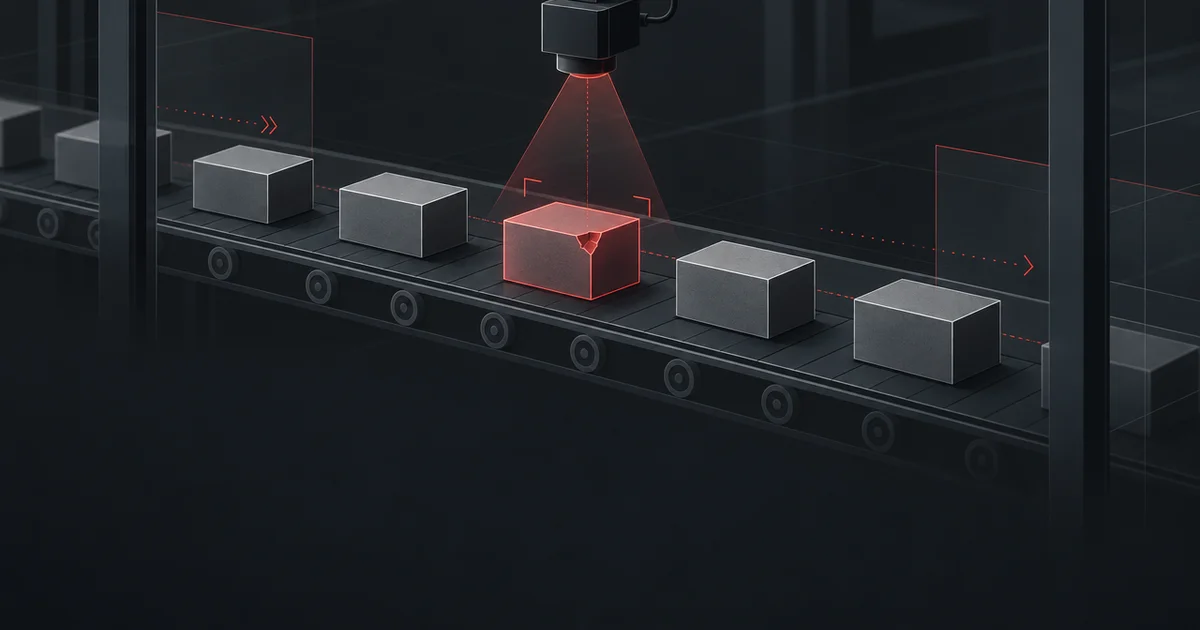
We build computer vision for quality control: camera and lighting selection, model labeling and training, line integration, and manual review of borderline cases.
Cameras find the defect before an operator, and borderline cases go to a person.
Pricing
from ₽2,500,000
per project
This is the lower bound of a project. We scope the exact quote after a brief: it depends on volume and the number of integrations.
Capabilities
Camera and lighting selection
Capture matters more than the model: we size geometry, lighting, and line speed for the task.
Labeling and training
We build the dataset, train the model, and measure accuracy on a held-out split, not the training one.
Manual review
Borderline cases go to an operator, and their decisions return to the labeling set.
Line integration
The result stops the line, writes to MES, or stays in a log, following the production rules.
From request to result
1
Line audit
We inspect the product, defects, and conveyor speed: which defects a camera can distinguish at all.
2
Capture scheme
We select cameras, lighting, and angle, and fix accuracy and miss-rate requirements.
3
Model training
We build and label the dataset, train, and measure accuracy on a held-out split.
4
Launch and retraining
We deploy inference on the line and close the loop: operator decisions return to the labeling set.
Check if it fits you
Good fit
A visible defect
Chips, cracks, and incomplete assembly are visible in a photo: a camera handles them.
Stable lighting and angle
Capture is controlled: the model does not retrain on random shadows.
Not a fit
A defect with no optical difference
A scratch under paint or an internal defect is invisible to a camera and needs other sensors.
No reference labeling
Without an agreed defect definition, the model has no correct answer to learn from.
What you get
96%
of defects caught without an operator
The camera rejected clear defects, and borderline decisions went to an operator and back into labeling.
What the delivery includes
A station audit
A station audit inspects the product, line speed, and the list of defects to catch. The class scope is fixed before the dataset is collected.
A capture scheme
We select the camera, lens, and lighting for the item geometry. A capture scheme sets frame quality before any training.
Dataset and labeling
We collect real frames, agree on the defect definition, and label. Dataset and labeling decide what the model learns.
Training and measurement
We count accuracy and miss rate on a held-out split, broken down by defect class. Training and measurement run before the line rollout.
Integration and acceptance
Output wired to the line, a decision log, and an agreed trigger threshold. Integration and acceptance close the pilot.
How the system is built
Capture matters more than the model
Good lighting and angle give the model a clean, stable frame, so we start with capture. Optics and angle come first, then the dataset, training, and the model's rollout on the line.
The dataset comes from real line frames
The dataset comes from real line frames, and rare defects enter labeling alongside common ones. Training runs before a check on a held-out split the model sees for the first time.
We measure accuracy on a held-out split
We measure accuracy on a held-out split and count defect misses separately: a miss on the line costs more than extra rejection. Every camera and operator decision lands in the log with its frame.
Inference runs next to the line
Inference runs next to the line and answers within tens of milliseconds, so the decision lands before the next item. Rejection fires on the spot while the conveyor keeps its own pace.


Where the solution pushes back
- 01
Borderline cases stay with a person
Borderline cases stay forever: stains and blurred edges are resolved with a person, and that is a standing cost.
- 02
A product change is a new dataset
A product change needs retraining: new geometry and a new defect make a separate dataset, so the threshold is tuned again and accuracy is confirmed by new measurements.
- 03
The defect boundary is subjective
Labeling is subjective: two operators draw the defect boundary differently, and the model learns from those disagreements.
- 04
Accuracy drops without retraining
Without retraining, accuracy drops: the defect distribution shifts, so the model is periodically updated on new confirmations.
- 05
The number of defect classes
Each new defect class needs its own frames and labeling. The number of defect classes drives the labeling volume and the project cost.
- 06
The share of borderline cases
The higher the share of borderline cases, the more manual review continues after launch. The share of borderline cases sets the operator load.
- 07
Line speed
The faster the flow, the tighter the inference latency requirement. Line speed sets the compute and hardware budget.
- 08
Product change frequency
Frequent changeovers require regular retraining, so the model is updated per product. Product change frequency sets the support cycle.
Technologies
The technologies we use in our work and their role in a project.
Capture and inference
Models train on PyTorch, line inference runs through TensorRT, frames and labels are stored in MinIO, and the decision log lives in PostgreSQL.
Cost calculator
This is an indicative range, not a quote. We scope the exact estimate after a brief: it depends on volume and the number of integrations.
Classes and detectors
Model complexity
Data labeling
Add-ons
Support
Year one: updates and monitoring, a reply within 2 business days.
Service
Building computer vision systems
The estimate covers our team's work. Hardware, third-party service licences and travel are added on request.
Estimated cost
₽3.1M
Timeline
7 wk
Frequently asked questions
How much data is needed to train?
It depends on the defect: a common one needs a few hundred labeled frames, a rare one thousands, including rare classes.
Who labels the defects?
A process engineer or operator labels with an agreed defect definition. We resolve disagreements before training, not after.
What about accuracy on new defects?
A new defect type is a new dataset. The model will not guess it, so the retraining loop is built in from the start.
How long does a pilot take?
A pilot on one station starts at four weeks: capture, dataset, training, and measurements on the live line.
Can it run on several stations?
Yes, one capture scheme copies to identical stations. We build it once, then move the cameras and switch thresholds.
What changes for the operators?
The operator stops checking every item and reviews only borderline frames. Their decisions return to labeling, so the load drops but does not disappear.
What teams add to this service
Related Services
Part of Solutions
Implementation Examples
−90%
Escaped defects
Ready to discuss your task?
Leave a request – we'll get back with a proposal and a preliminary estimate.
Contact us